
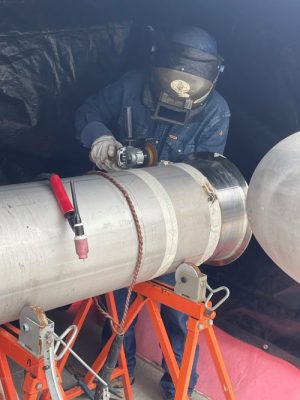
Here is what those forecasts leave out: 92% of contractors report difficulty filling positions, and the industry needs 349,000 new workers in 2026 just to keep pace with current demand.
Those two data points cannot both be true at once. Either the growth projections are overstated, or the projects that get built will cost significantly more and take significantly longer than anyone is budgeting for. Capital project directors who plan around the optimistic number without accounting for the labor reality are setting themselves up for painful surprises.
The Math That Market Reports Ignore
I have been watching this tension build for years, but 2026 is when it becomes unavoidable. The demand drivers are real—reshoring, EV battery plants, renewable energy infrastructure, critical mineral processing. The projects are being approved. The capital is available.
What is not available is the craft workforce to execute those projects on the timelines and budgets that the approval memos assumed.
Consider the arithmetic. If you need 349,000 additional workers and 92% of contractors cannot fill their current positions, the labor market is not tight—it is functionally broken. Every EPC contractor bidding work in 2026 is drawing from the same shrinking pool of welders, pipefitters, millwrights, and ironworkers. The contractors who win bids will poach from the contractors who do not. The projects that break ground will pull workers from projects that have not mobilized yet.
This is not a supply chain constraint you can engineer around with longer lead times or alternative vendors. It is a constraint that lives inside your schedule and your risk register whether you acknowledge it or not.
Why Projections and Reality Diverge
Market research firms build growth forecasts from capital expenditure announcements, permit filings, and macroeconomic indicators. They model demand. They do not model execution capacity.
A $50 million bulk handling facility does not get built because someone approved the budget. It gets built because a contractor can put 40 certified welders, 25 pipefitters, and a dozen millwrights on site for 14 months without losing half of them to a better offer across town.
The research from PCL’s 2026 Industry Outlook makes this explicit: the shortage is not theoretical, and it is not improving at the rate the industry needs. Apprenticeship programs are expanding, but they produce journeymen on five-year cycles. The demand curve is moving faster than the supply curve can follow.
What this means for capital project directors is that every project you approve in 2026 is competing for the same constrained resource. Your contractor’s ability to deliver is not just a function of their capability—it is a function of who else is building what else in the same labor market.
How Labor Constraints Actually Show Up in Projects
The visible symptom is schedule slip. The invisible cause is usually craft availability.
I have watched it happen the same way on a dozen projects. Contractor wins the work with a credible plan. Mobilizes on time. Hits the first milestone. Then somewhere around month three, the crew starts thinning out. Welders leave for a project that pays $2 more per hour. Pipefitters get pulled to a sister project that is behind schedule. Supervision stretches across too many fronts. Quality starts to drift. Rework accumulates. The schedule that looked achievable at notice to proceed starts looking fictional by the halfway point.
None of this shows up in market research reports. All of it shows up in your total installed cost.
What Labor-Driven Overruns Actually Cost
The direct cost is obvious—extended general conditions, escalated craft rates, and premium pay to hold crews. The indirect cost is worse. A bulk material handling project that runs three months long is a facility that misses a production window. A conveyor system that does not commission on schedule is throughput that does not happen. The carrying cost of a delayed asset is often larger than the construction overrun itself.
Owners who budget for market-rate labor without building in a realistic contingency for labor-driven delays are underestimating their total project
0 Comments